
History of Botswana demonstrates that grounded and thoughtful approach to nation building based on tradition preservation and cultural adaptation could provide unique pathway to decolonization against all odds. Landlocked nation with very little arable land and natural resources voluntarily become under British protectorate, enjoyed very little interest from occupational forces.
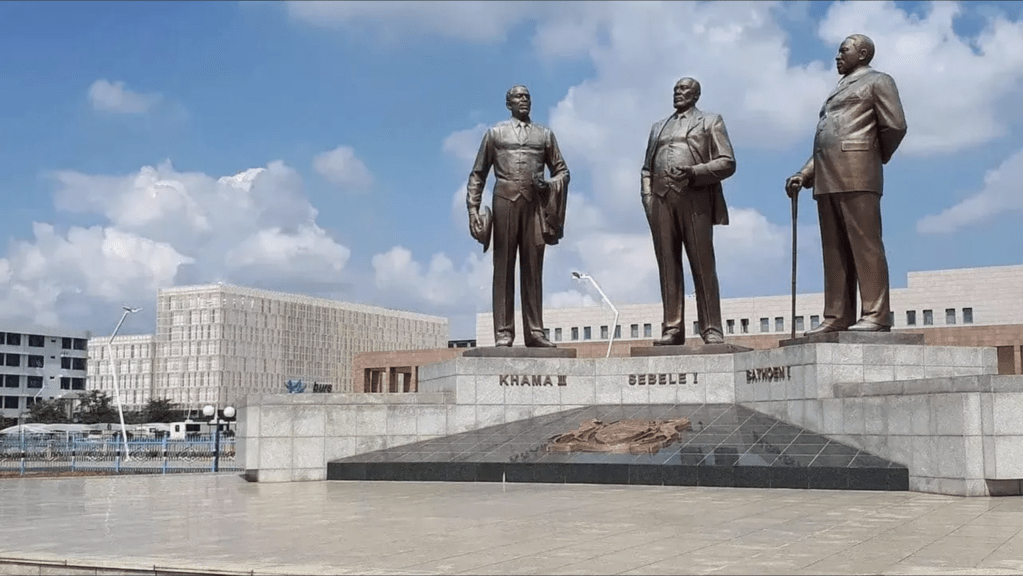
By the time Bechuanaland became independent in 1966 under the name Botswana, the lucky success of chiefs Sebele, Bathoen, and Khama was long in the past. In the intervening years, the British invested little in Bechuanaland. At independence, Botswana was one of the poorest countries in the world; it had a total of twelve kilometers of paved roads, twenty-two citizens who had graduated from university, and one hundred from secondary school.
…
Early stages of independence would play out very differently in Botswana, again largely because of the background created by Tswana historical institutions. In this, Botswana exhibited many parallels to England on the verge of the Glorious Revolution. England had achieved rapid political centralization under the Tudors and had the Magna Carta and the tradition of Parliament that could at least aspire to constrain monarchs and ensure some degree of pluralism. Botswana also had some amount of state centralization and relatively pluralistic tribal institutions that survived colonialism. England had a newly forming broad coalition, consisting of Atlantic traders, industrialists, and the commercially minded gentry, that was in favor of well-enforced property rights. Botswana had its coalition in favor of secure procedure rights, the Tswana chiefs, and elites who owned the major assets in the economy, cattle. Even though land was held communally, cattle was private property in the Tswana states, and the elites were similarly in favor of well-enforced property rights
…
Independence was also a relatively orderly affair. The drive for independence was led by the Botswana Democratic Party (BDP), founded in 1960 by Quett Masire and Seretse Khama. Khama was the grandson of King Khama III; his given name, Seretse, means “the clay that binds together.” It was to be an extraordinarily apt name. Khama was the hereditary chief of the Ngwato, and most of the Tswana chiefs and elites joined the Botswana Democratic Party. Botswana didn’t have a marketing board, because the British had been so uninterested in the colony. The BDP quickly set one up in 1967, the Botswana Meat Commission.
…
Botswana achieved remarkable growth rates after independence because Seretse Khama, Quett Masire, and the Botswana Democratic Party led Botswana onto a path of inclusive economic and political institutions. When the diamonds came on stream in the 1970s, they did not lead to civil war, but provided a strong fiscal base for the government, which would use the revenues to invest in public services. There was much less incentive to challenge or overthrow the government and control the state. Inclusive political institutions bred politi- cal stability and supported inclusive economic institutions. In a pattern familiar from the virtuous circle described in chapter 11, inclusive economic institutions increased the viability and durability of inclu- sive political institutions.
Botswana broke the mold because it was able to seize a critical juncture, postcolonial independence, and set up inclusive institutions. The Botswana Democratic Party and the traditional elites, including Khama himself, did not try to form a dictatorial regime or set up extractive institutions that might have enriched them at the expense of society. This was once again an outcome of the interplay between a critical juncture and existing institutions. As we have seen, differently from almost anywhere else in sub-Saharan Africa, Botswana already had tribal institutions that had achieved some amount of centralized authority and contained important pluralistic features. Moreover, the country had economic elites who themselves had much to gain from secure property rights.
Acemoglu, Daron; Robinson, James A. , Why Nations Fail The Origins of Power, Prosperity and Povety – Crown Buisness NY, 2013 pp. 409-413









 PROsociotech