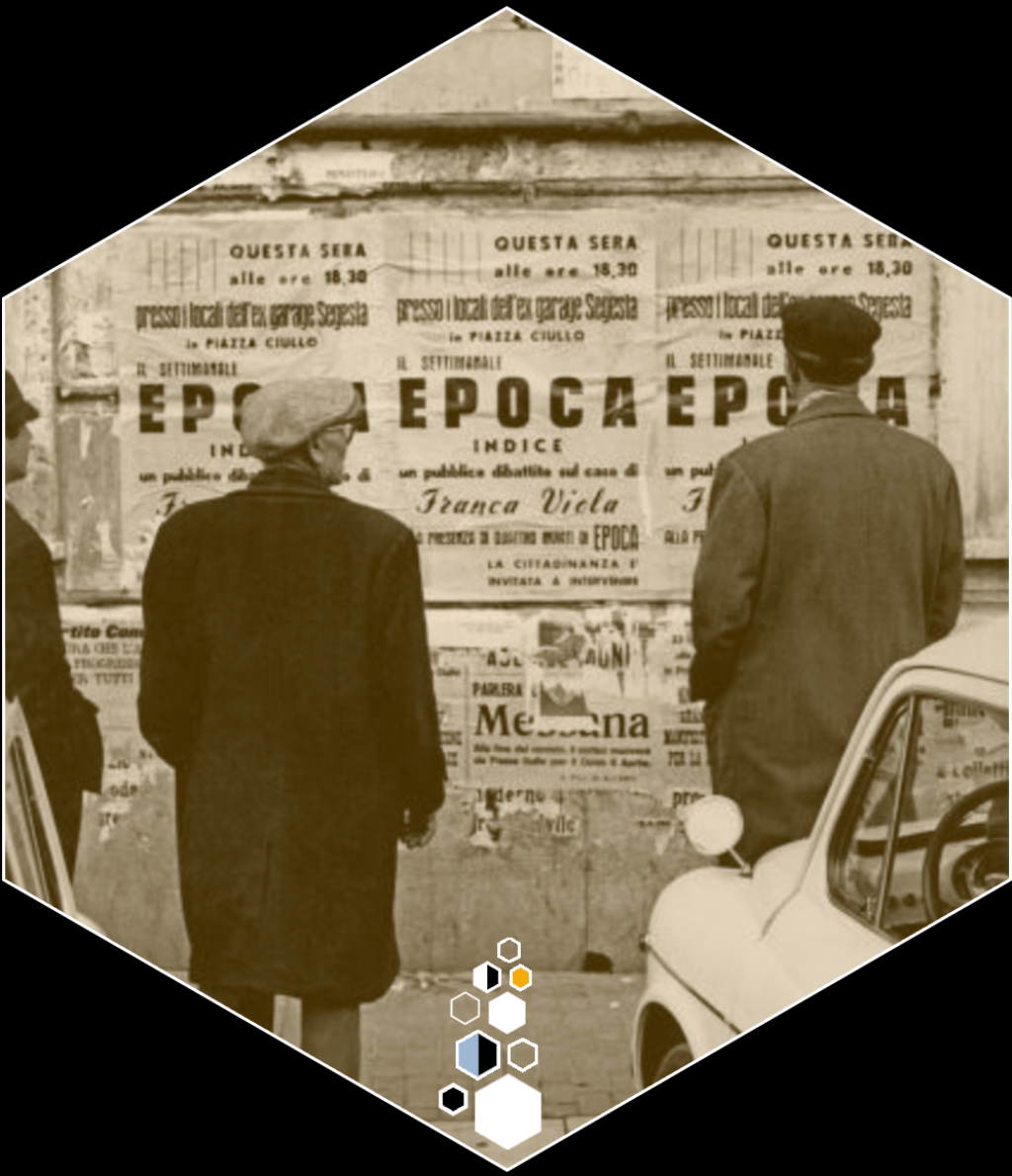
On 26 December 1965 seventeen-year-old Franca Viola was abducted from her home in the town of Alcamo in western Sicily by a group of armed men led by her former fiancé, Filippo Melodia. Both her mother and younger brother were at home with her and Franca was not abducted without a struggle. When she was bundled into the getaway car Viola’s mother Vita Ferro was briefly dragged along with the vehicle and was left bleeding on the street. Franca’s brother Mariano would not let go of her and was thus taken with her in the car, only to be returned to the outskirts of the village hours later. Franca herself was not found for a week, despite an immediate and extensive police search of the area. Her ordeal came to a dramatic end when police stormed the nearby home of Filippo Melodia’s sister, where he had been hiding out with Viola. Melodia made one last desperate and defiant stand by attempting to flee onto the rooftops with Viola before he was taken into police custody.
The details of Franca Viola’s abduction were at once both familiar and unusual to onlookers in 1960s Sicily. It was a somewhat recognised Sicilian practice to kidnap a young woman in order to force her into marriage. The logic of such kidnaps rested on the notion that a woman’s honour was measured by her sexual chastity. Once her honour had been compromised by spending time alone with a man – although rape was common in such cases, sexual violence was considered of secondary importance to the loss of honour as a social value – she could only repair it through marriage to her abductor. Since the loss of honour affected not just the woman but also her family, parents and siblings would typically also be invested in securing the marriage. The concept of ‘reparatory marriage’ – in which the crime of rape could be absolved through marriage – was present in the Italian legal code until 1981. However, such practices were more prevalent in rural Calabria and Sicily, the primary focus of this article.
Although the honour system was being challenged by migration, the rise of mass culture and the creeping urbanisation of Sicily itself, it still held real currency up until the 1960s. Murder for the sake of honour – usually defined as the killing of a woman’s lover by her husband, father or brother – was the more dramatic, violent and public face of honour crime. Such cases, although treated with greater leniency than other murder cases by the Italian legal system, generally did go to court. This notion of honour crime was so familiar to the public that it is strongly suspected that many Sicilian honour killings were in fact passed off as such by the mafia to receive shorter sentences. Abduction with the aim of forced marriage was, by contrast, usually a more private affair, resolved between families rather than by the law. During the same weeks as Franca Viola’s abduction the Sicilian daily Giornale di Sicilia carried details of several other abductions of young women. They always ended with charges being dropped and the promise of marriage. The vast majority of such cases likely never even made it to the newspapers.
The honour system also necessitated strict control of women’s movements, and since unmarried women in rural Sicily typically had little opportunity to meet men in public and to choose a marriage partner by themselves, couples often took the drastic step of elopement – known as a fuitina – in order to secure a love marriage.8 Steps might also be taken to make an elopement appear like a abduction in order to preserve the woman’s reputation. It was thus often difficult to tell whether the incident in question was a violent abduction or the desperate, romantic gesture of a couple in love. It was this ambiguity between love, coercion and violence that lay at the heart of the ‘fuitina’, which Melodia and his accomplices doubtless hoped to exploit with their actions. They also acted under the assumption that family and community would demand a marriage between the two, thus bringing the case to a familiar close.
The case was also in many respects quite unusual from the beginning, and several crucial details served to lift it out of the domain of the familial, private and local and into the public, national sphere of media and courtroom. The level of violence used in Viola’s kidnap appeared excessive by the standards of most abductions for the scope of marriage. Generally abductions happened in public spaces; by the logic of the honour system, which dictated that modest women should keep to the domestic sphere, it could be argued that they had somehow colluded in their abduction. Franca Viola, however, was forcibly taken from her home, in the presence of her mother and brother. The fact that the kidnappers had carried arms and fired warning shots in front of family and neighbours also pointed to the fact that this was no ordinary ‘fuitina’, in which the boundaries between love and coercion could not easily be drawn. It was quite clearly a violent crime. Even in the interior of western Sicily, where the tolerance of violence in ordinary life was higher due to the presence of the mafia, Viola’s kidnap had crossed the boundary of what was acceptable.
While such kidnaps often reached the local pages of the Sicilian newspapers, the Viola kidnapping made the front headlines of both Sicilian dailies and, unlike most other cases, was widely reported in the major Italian newspapers. Both the length of Viola’s incarceration and the nature of its conclusion were also noteworthy; most abductions ended within a couple of days at most, with the return of the couple to the young woman’s parents and the promise of a marriage that all parties would now agree upon. Viola however was only freed after seven days by a police raid, and Melodia was taken into immediate custody.
From the beginning, it was also clear that this was no ‘ordinary’ elopement or abduction. There were hints of mafia involvement early on, but, in addition, the Viola family refused to play the part assigned to them in this familiar family drama. Instead of negotiating with the abductors to settle the matter privately, they had immediately turned to the law. However, even at this point it was not clear that the case would become the national event that it did. It was Franca Viola’s decision, strongly supported by her father, Bernardo Viola, to refuse the reparatory marriage that was offered, which then necessitated the prosecution of Filippo Melodia and his accomplices in a high profile trial the following December, that ultimately marked this case out as a watershed event in the history of modern Italian marriage, sexual and gender politics.
[…]
The trial raised many questions regarding family, marriage and love itself, as well as the nature of Italian masculinity. It also provoked debate about the rate at which society was changing and the regional dimensions of this transition. Italy had undergone rapid and profound change in the preceding decade, transformed by an strong industrial boom in the northern cities from a poor, rural nation recovering from war into a prosperous, proud and self-consciously modern society. When public opinion was drawn to the southern peripheries of the nation by the 1966 trial, it stirred anxieties and provoked questions not only about love, sexuality and gender politics, but also about how Italy should define itself as a nation. What emotional styles were acceptable within the nation and was Italy ‘modern’ and European or southern and ‘traditional’? What was the place of Sicily within the new nation emerging by means of the economic miracle, and could regional differences be tolerated or did they have to be flattened out?
This was not the first time that an Italian murder case had magnified tensions between competing emotional styles and masculinities, reflecting anxieties about how Italy should define itself as a nation. In 1879 the murder of army captain Giovanni Fadda by his wife’s lover had provoked similar concerns. The restrained and respectable masculinity of Fadda was contrasted with the brash and passionate style of his murderer Pietro Cardinali and with his wife’s roots in Calabria, where, in the words of the state prosecutor, ‘the passions were more alive’. The civilised, bourgeois heart of the newly unified nation was perceived to be under threat from those at its passionate and untamed peripheries. In 1966 the nation was yet again seeking to define itself – not just as unified, but as prosperous, modern and European. The media coverage of the Viola case thus carried at its core a long running debate about national identity, southern ‘difference’ and the very meaning of modernity for Italian society.
[…]
Honour crime in particular was highlighted as a dramatic reminder of the cultural differences between northern and southern Italians, for the Piedmontese. However, when polled, there were marked regional differences in the attitudes of southern men towards such crimes; those from Calabria, Sicily and Sardinia were much more likely to tolerate the notion of honour crime than those from other southern regions. Those from the southernmost tip of Italy and from its islands were thus perhaps the most alien to the sensibilities of self-consciously modern and progressive northern Italy, and migration was bringing both groups into much closer contact than before. When the kidnap of Franca Viola brought these issues to the fore, media debates were to reflect anxieties about regional character and national identity and questions concerning what kind of behaviour could be considered modern, Italian and therefore acceptable and what lay outside the imagined boundaries of the nation.
[…]
The case of Franca Viola forced the Italian public to confront the issue of gender violence and its cultural and social place within the nation. While honour killings were public events in which both victim and perpetrator were usually men, familiar to the point of being a cliché of southern society, kidnapping and forced marriage were usually much more private affairs, resolved within the family rather than by the law. Confronting these issues involved an uneasy confrontation with a region long considered as ‘other’ and marginal within the nation. However, the case also came at a time when southern Italians were more visible across the nation than before due to the migration waves of the 1950s and 1960s. In confronting the issues at the heart of the Viola case, northern Italians were also coming to terms with what was often seen as the other within their own cities – the southern migrant.
Emotions were key to how Sicily was represented; it was difficult to separate crimes of honour from crimes of passion in the Italian legal code. Given that Sicily in the 1960s was also associated above all with the mafia, Melodia could be mapped all too easily onto the familiar image of the violent and emotional Sicilian man. However, although Melodia was clearly being tried for a crime associated with honour, the legal and media battle was fought primarily on competing definitions of love: the Sicilian tradition of love through glances usually intertwined with drama and tragedy, or the apparently modern notion of marriage based on choice, equality and companionship. The ambiguity between love and violence in the former style again points to the difficulty of separating emotions from gender violence and honour crime, a challenge reflected in the press coverage. In casting one style as ‘backward’ and Sicilian and the other as ‘modern’, Sicily was again associated with brutality and with the past.
The coverage of the trial, and particularly of Melodia himself, slipped into the language of racism and stereotype on a number of occasions, with Sicily being cast in familiar terms as dark, backward, medieval, tribal and African; such terms reflected not only historic prejudice but more urgent concerns about how Italy wished to position itself in the changing world of the 1960s. By means of its northern industrial boom, Italy had managed to transition to a largely urban consumerist society, comparable economically with the rest of Europe. Its southern peripheries were a reminder of the messy and incomplete nature of the rapid social and cultural transition which the nation had undergone in the previous decade, and the constant media refrains of ‘modernity’ and ‘backwardness’ reflected these national anxieties. However, even in hailing the progressive elements in Sicilian society, the media failed to fully appreciate the gendered and familial nuances of Sicilian society. In turning Franca Viola, whose own words are seldom heard in 1966 or afterwards, into an icon of feminism – while rarely engaging with the meaning of her experience – her own subjective experience as a Sicilian woman was largely passed over. Ultimately the various Sicilies created by the Italian media in 1966 – both the ‘backward’ and the ‘modern’ ones – are projections of national anxieties and needs and reflected a failed encounter with Sicily itself.
Cullen, N., The case of Franca Viola: Debating Gender, Nation and Modernity in 1960s Italy – Cambridge University Press, Contemporary European History. 2016;25(1):97-115. WEB 2024










 PROsociotech