While many different factors influence the safety of humans in cities, none matters nearly so much as the speed at which vehicles are traveling. The relationship between vehicle speed and danger is, to put it mildly, exponential.
The diagram at right is one of many that can be found to communicate this relationship. Others show people falling out of buildings, with 20 mph equaling the second floor and 40 mph equaling the seventh. The basic message to remember is that you are about five times as likely to be killed by a car going 30 as a car going 20, and five times again as likely to be killed by a car going 40.
This threshold zone of 20 to 40 mph, is basically where it all happens—the difference between bruises, broken bones, and death. And 20 to 40 is roughly the range of speeds that we find cars traveling on the best downtown streets. Keeping cars on the lower end of that range, therefore, must be the central objective of urban street design.
The speed of the impact itself is not the only factor. As cars move faster, the likelihood of a crash also rises. Drivers and pedestrians alike have less time to respond to conflicts, stopping distances lengthen, and the driver’s cone of vision narrows. These factors multiply the impact of speed beyond those indicated in the above graph. It is safe to say that a car traveling 30 mph is probably at least three times as dangerous as one going 25.
Many cities have a downtown speed limit of 25. All should—or lower, as discussed in Rule 34. These limits simplify the conversation, because it is no longer necessary to talk about “slowing drivers down.” Who wants to be slowed down? That sounds like congestion.
Instead, we can simply talk about “reducing illegal speeding.” Streets need to be redesigned so that fewer people will speed on them. This cannot be accomplished with speed limits alone, because people do not drive the posted speed; they drive the speed that is implied by the street design. Streets must be designed to encourage the speeds that we have set for them, or the result will be illegal, deadly speeding. That is the central message, and the street designer’s mandate.

[…]
Yield Flow
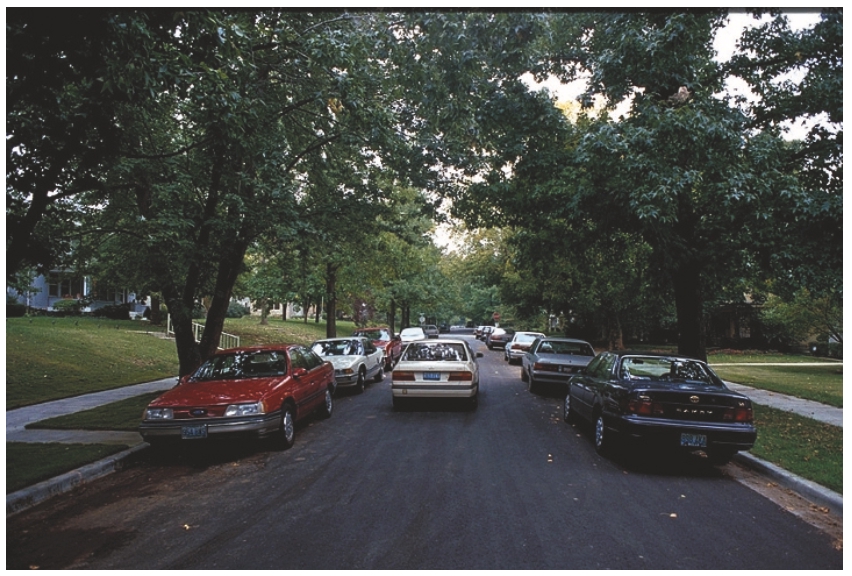
If you had the privilege of growing up in one of America’s older single-family neighborhoods, you probably spent much of your outdoor time playing in skinny streets. It truly was a privilege to live in an environment where your parents could let you roam free without fearing what has become the leading cause of death for children. One reason that car crashes kill more children than they used to is the eradication from the development codes of the “yield street.” Yield streets are thoroughfares in which a single driving lane about 12 feet wide handles travel in both directions. This sounds preposterous, which is one reason why they were eradicated by people who clearly did not have eyes to see, since they exist almost everywhere and are inevitably the most desirable streets in any city.
But why trust experience when logic is so obvious: how can two cars possibly pass each other in a mere 12 feet? The answer is found in the parking lane, where gaps between cars offer the opportunity to pull over slightly when another car approaches. This maneuver happens every day in thousands of yield-flow streets around the United States, and the fact that it is necessary is what makes yield-flow streets the safest streets of all.
Again, there is no hard rule, but a street serving only single-family homes—freestanding or rowhouses—experiencing fewer than 150 trips at peak hour is a good candidate for yield flow. A yield-flow street should be about 20 feet wide if it is parked on one side, and about 26 feet wide if parked on both sides.
Speck, J., Walkable City Rules: 101 Steps to Making Better Places – Island Press 2018, WEB 2024 pp. 74-75, 119













 PROsociotech